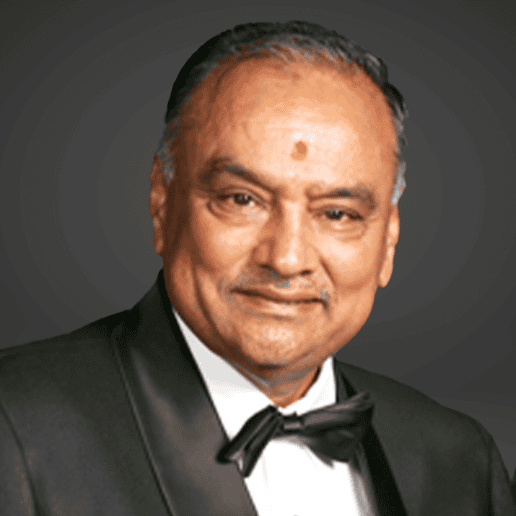
Formal close portrait of Rajnikant S. Ajmera in a black dinner jacket and bow tie
Rajnikant S. Ajmera Formal portrait

About  /  Profile

A builder,
and a company
he made public.

Rajnikant S. Ajmera has spent more than four decades in construction and real estate, almost all of it inside a single Mumbai enterprise that he helped grow from a family construction business into a listed development company.

Chapter 01 — Introduction

The long apprenticeship

Careers in Indian real estate are rarely straight lines. Firms rise on a single successful project and vanish on the next; principals move between ventures; names change with the market. Set against that, the professional life of Rajnikant S. Ajmera reads almost as an anomaly — more than four decades of work, and an association with one enterprise stretching across five.

He is a civil engineer by qualification, and the discipline shows in how the business has been run. Engineering is a profession of tolerances and sequences: things are specified, executed and checked, and a structure either stands to standard or it does not. Carried into a development company, that habit of mind produces a particular emphasis — on completing what has been started, on certification and process, and on the physical quality of what is finally handed over.

He serves as Chairman and Managing Director of Ajmera Realty & Infra India Limited, the Group's listed flagship, and as Chairperson of the wider Ajmera Group.

Chapter 02 — Background

The firm he extended

The Ajmera Group was founded in 1968 by the late Shri Chhotalal S. Ajmera, known throughout the trade as Chhotubhai. Born on 27 September 1937 in the village of Vasavada in Gujarat, he left formal education in 1968 to enter business, arriving in Mumbai after a series of small ventures — oil trading, textile trading, fabrication, foundry work, paper. The construction business grew out of that restless commercial beginning.

Rajnikant Ajmera worked alongside the founder. The early record of the Group is a record of housing delivered at pace: the Ajmera Housing Complex at Pimpri in Pune, running to roughly one hundred thousand square feet, was the break that established the firm's capacity to build colonies rather than individual buildings.

The company that carries the name onto the stock exchanges has its own history. It was incorporated in 1985 as Percolated Steels Limited, and renamed Ajmera Realty & Infra India Limited in 2009 — the year Rajnikant Ajmera assumed the office of Managing Director. It trades today on the BSE under code 513349 and on the NSE as AJMERA.

Managing Director since 2009. Chairman of the Board since 2012. Reappointed in 2024 for a term running to 2029.

From the company's board record
Chapter 03 — Professional identity

Engineer first

It matters that the person at the head of this company trained as a civil engineer rather than as a financier. Development businesses can be run as land arbitrage, in which case the building is incidental to the transaction. Run by an engineer, the building tends to be the point.

That orientation is visible in one specific, documented commitment: the Group's pursuit of formal quality certification. He was instrumental in securing ISO 9001 certification for the Group's processes — initially under the ISO 9000:2000 standard and subsequently under ISO 9001:2015. Certification of that kind is not a marketing exercise; it obliges a company to write down how it works and then to be audited against its own description.

The second visible marker is scope. A firm that begins with housing colonies and ends up listed on two exchanges has had to build not only structures but systems — governance, disclosure, and the capacity to answer to shareholders as well as to residents.

Chapter 04 — Experience

Scope of responsibility

Under his direction, operations extended across four Indian cities — Mumbai, Pune, Bengaluru and Ahmedabad — each a distinct regulatory and market environment rather than a simple extension of the last. The Group also took part in the Bahrain Bay development at Manama, working jointly with the Mayfair Group, which placed an Indian family developer inside an international waterfront scheme.

The largest single undertaking in Mumbai is Bhakti Park at Wadala. Construction on its first phase began in 1996. Its second phase houses around two thousand families and is built around a twenty-five acre garden, among the largest in the city. In 2010, jointly with the Bakeri Group, the Group acquired the Calico Mills property in Ahmedabad for approximately ₹350 crore — a mill-land transaction of the kind that reshapes an inner-city district. In 2023 the company took on a redevelopment project at Borivali in Mumbai.

Alongside real estate and construction, the Group holds interests in cement, steel rolling and seamless capsules, and has moved into renewable generation: Ajmera Biofuel holds a 49 per cent stake in a solar project at Osiyan near Jodhpur, and Contra Power was established in 2012 for solar power generation.

Chapter 05 — Values

What the record values

Read across five decades, three commitments recur without needing to be declared.

Completion. The reputation of the firm was established by delivering housing colonies quickly and in full. In a sector where the most common failure is the unfinished project, the ability to hand over is itself the differentiator.

Verification. The insistence on ISO certification, and the decision to operate as a listed company subject to disclosure, both point the same way: a preference for being checked rather than trusted.

Contribution beyond the firm. Time given to MCHI, CREDAI and CORSMA is time not spent on the company's own projects. It is spent instead on the framework within which every firm in the sector operates.

Chapter 06 — Approach

How the work is organised

Three features of the approach can be read directly from what has been built and disclosed.

The first is scale by neighbourhood, not by tower. Bhakti Park is not a building but a district, with a garden at its centre and thousands of households around it. Planning at that grain requires a longer horizon than a single-building pro forma allows.

The second is geographic patience. Four cities over four decades is deliberate rather than opportunistic expansion — each market entered, and then held.

The third is industrial breadth held around a core. Cement, steel and solar are not unrelated adventures; they sit close to the inputs and the infrastructure of building.

Chapter 07 — Expertise

Areas of expertise

  • 01Residential and commercial real estate development
  • 02Township and large-format housing planning
  • 03Civil engineering and construction management
  • 04Quality systems and ISO 9001 process certification
  • 05Listed-company governance and board leadership
  • 06Industry representation and regulatory engagement
  • 07Land acquisition and mill-land redevelopment
  • 08Diversified industrial and renewable energy interests
Chapter 08 — Perspective

Representation and recognition

He has held the office of President of the Maharashtra Chamber of Housing Industry, and has served within CREDAI — the Confederation of Real Estate Developers' Associations of India — in the capacities of President and Vice President. Outside property, he was President of CORSMA, the Cold Rolled Steel Manufacturers Association of India, for many years.

These are the rooms in which a sector's rules are argued over: contract norms, approval regimes, buyer protection, standards of disclosure. The work is unglamorous and largely invisible to the public, and it is the part of a developer's contribution that outlasts any individual project.

In 2019 he received the Lifetime Achievement Award at the 11th Realty+ Excellence Awards. He has also established several schools.

Chapter 09 — Closing

A record still open

In July 2024 the Board approved his reappointment as Chairman and Managing Director for a further five years, to 31 July 2029 — a term beginning after he had passed seventy. Whatever else it signals, it indicates that the institution he has led for most of its life is not yet finished with him.

The chronology behind this profile — from the founding of the Group in 1968 to a board term running to 2029.

Continue toJourney